
Sarah Brown, Sabrina Demetrioff, Wan Wang, & Alicia Nijdam-Jones
Study Summary
Background: Rooted in the enduring and intergenerational impacts of colonization, First Nations, Inuit, and Métis (FNIM) people have disproportionately high rates of mental illness and criminal legal involvement across Canada. However, relative to their overrepresentation in the Canadian criminal legal system, FNIM peoples are underrepresented in forensic mental health services, a system that delivers specialized care to individuals with severe mental illness involved in the legal system. The reason for this disparity and where it occurs along the pathway into forensic services remains poorly understood.
The aim of the present study was to explore whether systemic and social inequities influence FNIM adults’ referral and access to forensic services in Manitoba. Our study had two research objectives:
- Do FNIM individuals face systemic and social inequities during the forensic assessment process that disproportionately affect their access to forensic mental health treatment and services?
- Do FNIM individuals face systemic and social inequities prior to their contact with forensic services that disproportionately impact their access to forensic services in Manitoba?
We hypothesized that:
- FNIM individuals would be less likely to be referred for court-ordered NCR assessments compared to White individuals.
- FNIM individuals referred for court-ordered NCR assessments would be exposed to significantly more social determinants of criminalization (i.e., educational attainment, early criminal legal system contact, and substance-related difficulties) than White persons.
- FNIM accused persons would experience significantly longer periods of time between assessment order and completion of court-ordered NCR assessments compared to White accused persons, and this relationship would exist after controlling for age, gender, and most severe index offence charge.
- Experts would be significantly less likely to recommend NCR eligibility for FNIM individuals than for White individuals, and this relationship would exist after controlling for age, primary mental health diagnosis, substance use at time of index offence, and most severe index offence charge.
- The relationship between NCR-recommendation and ethnicity would be significantly mediated by the total number of social determinants of criminalization.
Methods: This study employed a retrospective, cross-sectional design to examine the differences between FNIM (n = 222) and White (n = 174) individuals referred for court-ordered criminal responsibility assessments in Manitoba between 2003 through 2019. Quantitative data were analyzed descriptively and using participants’ sociodemographic, clinical, and criminological information. Chi-square analyses and Mann-Whitney U-tests were used to compare FNIM and White individuals across variables. Regression and mediation analyses were used to examine the influence of social determinants of criminalization, psychiatric diagnosis, index offence, substance use at time of offence, and age on the relationship between independent and dependent variables.
Results: Contrary to what was hypothesized, FNIM individuals (56.1%) were not underrepresented in referrals to forensic services compared to White individuals (43.9%). However, FNIM individuals were significantly younger at time of assessment, had higher rates of intellectual disability/neurodevelopmental disorders, and were significantly more likely to have both past and current substance-related diagnoses compared to White individuals. As hypothesized, FNIM individuals experienced significantly more social determinants of criminalization (less than high school education; past or current substance use diagnosis; contact with the CLS prior to age 18) at time of assessment.
A logistic regression revealed that experts were significantly less likely to recommend NCR eligibility for FNIM individuals compared to White individuals, even after controlling for age, index offense, primary psychiatric diagnosis, and substance use at time of offence.
Binary Logistic Regression Examining the Association Between Recommendation of NCR Eligibility and Ethnicity
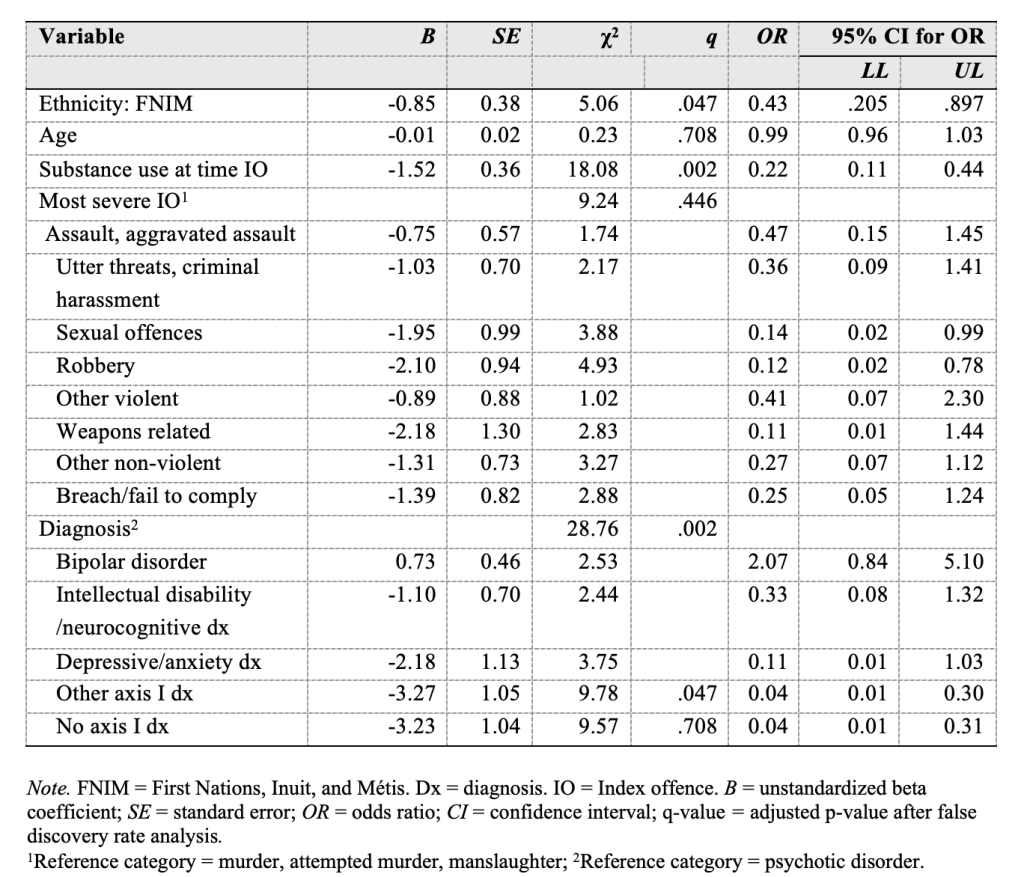
Note. FNIM = First Nations, Inuit, and Métis. Dx = diagnosis. IO = Index offence. B = unstandardized beta coefficient; SE = standard error; OR = odds ratio; CI = confidence interval; q–value = adjusted p-value after false discovery rate analysis.
1Reference category = murder, attempted murder, manslaughter; 2Reference category = psychotic disorder.
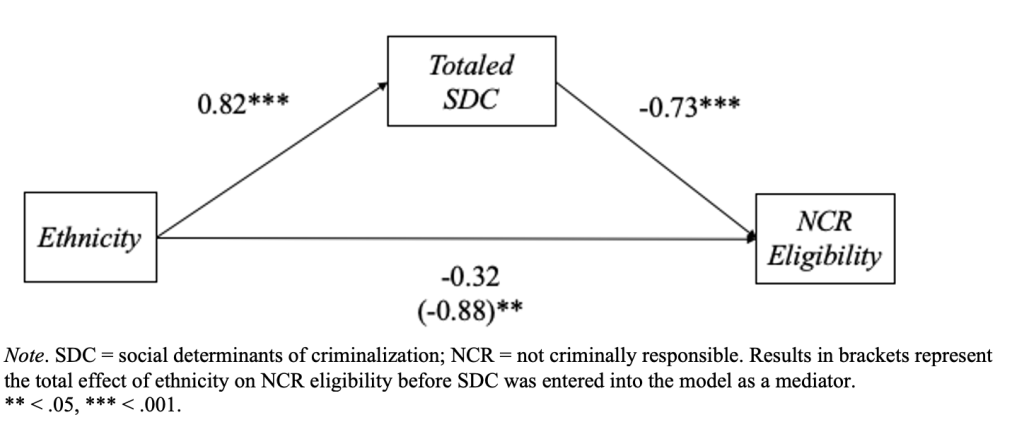
A mediation analysis demonstrated that the relationship between ethnicity and expert recommendation was significantly mediated by total social determinants of criminalization, aligning with what was hypothesized.
Mediation Model of Ethnicity on Expert Recommendation through Totaled SDC
The hypotheses summary below provides a summary of the findings of this study.
This study indicated support for hypotheses 2, 4, and 5 but not hypotheses 1 and 3.
Hypotheses Summary
| Hypothesis | Support for Hypothesis |
| Hypothesis 1 FNIM individuals would be less likely to be referred for court-ordered NCR assessments compared to White individuals. | No. FNIM individuals were not more likely to be referred for court-ordered NCR assessments compared to White individuals. |
| Hypothesis 2 FNIM individuals referred for court-ordered NCR assessments would be exposed to significantly more social determinants of criminalization (i.e., educational attainment, early criminal legal system contact, and substance-related difficulties) than White persons. | Yes. There was a statistically significant difference in the totaled SDC between groups, whereby FNIM individuals had significantly more social determinants of criminalization present at time of assessment as compared to White individuals. |
| Hypothesis 3 FNIM accused persons would experience significantly longer periods of time between assessment order and completion of court-ordered NCR assessments compared to White accused persons, and this relationship would exist after controlling for age, gender, and most severe index offence charge. | No. The period of time between assessment order and completion of court-ordered NCR assessments did not significantly differ between FNIM and White individuals. |
| Hypothesis 4 Experts would be significantly less likely to recommend NCR eligibility for FNIM individuals than for White individuals, and this relationship would exist after controlling for age, primary mental health diagnosis, substance use at time of index offence, and most severe index offence charge. | Yes. Compared to White individuals, FNIM individuals are statistically significantly less likely to have an expert recommend NCR eligibility for one or more index offences, which remained significant after controlling for age, primary mental health diagnosis, substance use at time of index offence, and most severe index offence charge. |
| Hypothesis 5 The relationship between NCR-recommendation and ethnicity would be significantly mediated by the total number of social determinants of criminalization. | Yes. Totaled SDC statistically significantly mediated the relationship between ethnicity and NCR-recommendation, indicating that that SDC is the underlying mechanism through with ethnicity is linked to expert recommendation for NCR eligibility. |
Note. FNIM = First Nations, Inuit, and Metis. NCR = Not Criminally Responsible. SDC = Social determinants of Criminalization.
Significance & Recommendations: Findings indicate that FNIM adults involved in the criminal legal system face significant barriers in accessing forensic services, which are rooted in colonial legacies and discrimination that begin before they encounter services and continue throughout the forensic assessment process. The same colonial legacies that increase an FNIM individual’s risk of involvement in the criminal legal system reduce their chances of receiving specialized mental health services.
The present findings underscore the urgent need for further examination and revision of the forensic assessment process, including integrating culturally and structurally relevant factors and reallocation of resources, such as increased clinician time, training, and funding for assessments involving FNIM individuals. Our results also highlight the need for policy-level changes, including integrating knowledge about the impacts of colonial legacies on FNIM individuals in legal and clinical psychology training; recruiting and increasing the number of FNIM employees or assessors’ capacity to work with community partners; and developing and implementing a culturally safe model of forensic mental health care.
Research Team and Acknowledgments
Our research team includes graduate and undergraduate students and faculty from the University of Manitoba. We have experience in clinical and forensic psychology, and some of us have worked with individuals involved in the forensic mental health system in our clinical practice and research.
Sarah and Alicia met with the North Hawk Elder Circle twice to discuss the research design, analysis plan, results, and how to meaningfully share the study findings. We would like to thank Elder Michael Pierre, Charles Wood, and McKenna Claeys for sharing their expertise, time, and feedback throughout this study. This project would not have been possible without their guidance and willingness to be involved.
Lastly, I would like to thank and acknowledge the study participants whose experiences in the justice and forensic mental health systems guided this research. We are also grateful to Adult Forensic Services for allowing us to access and use their data for this research.
Research Materials
This research was conducted for Sarah’s master’s thesis, and we are in the process of publishing our findings within a peer-reviewed academic journal. A more detailed overview of the study can be found in her thesis defence slides:
The pre-registration for this study is available on the Open Science Framework at 10.17605/OSF.IO/U2XKA
For more information about this study, please contact Sarah Brown at browns23@myumanitoba.ca and Alicia Nijdam-Jones at alicia.nijdam jones@umanitoba.ca

