

Madison P. Hardman, McKenna Claeys, Kasmira Sobkow, Leslie Roos, & Alicia Nijdam-Jones
Study Summary
Background: The number of women involved with the Canadian criminal legal system has been increasing, but few studies have explored the mental health experiences of women on probation and parole. Our study had two aims:
We also wanted to understand how participants’ intersecting experiences, such as their gender and being a mother, shaped their experiences.
- To learn what types of mental health services women on probation and parole are using, what factors make it easier and harder for them to seek help, what services they prefer to use, and how they care for their well-being;
- To understand how being involved with the criminal legal system has impacted their mental health and decisions to seek or not seek supports.
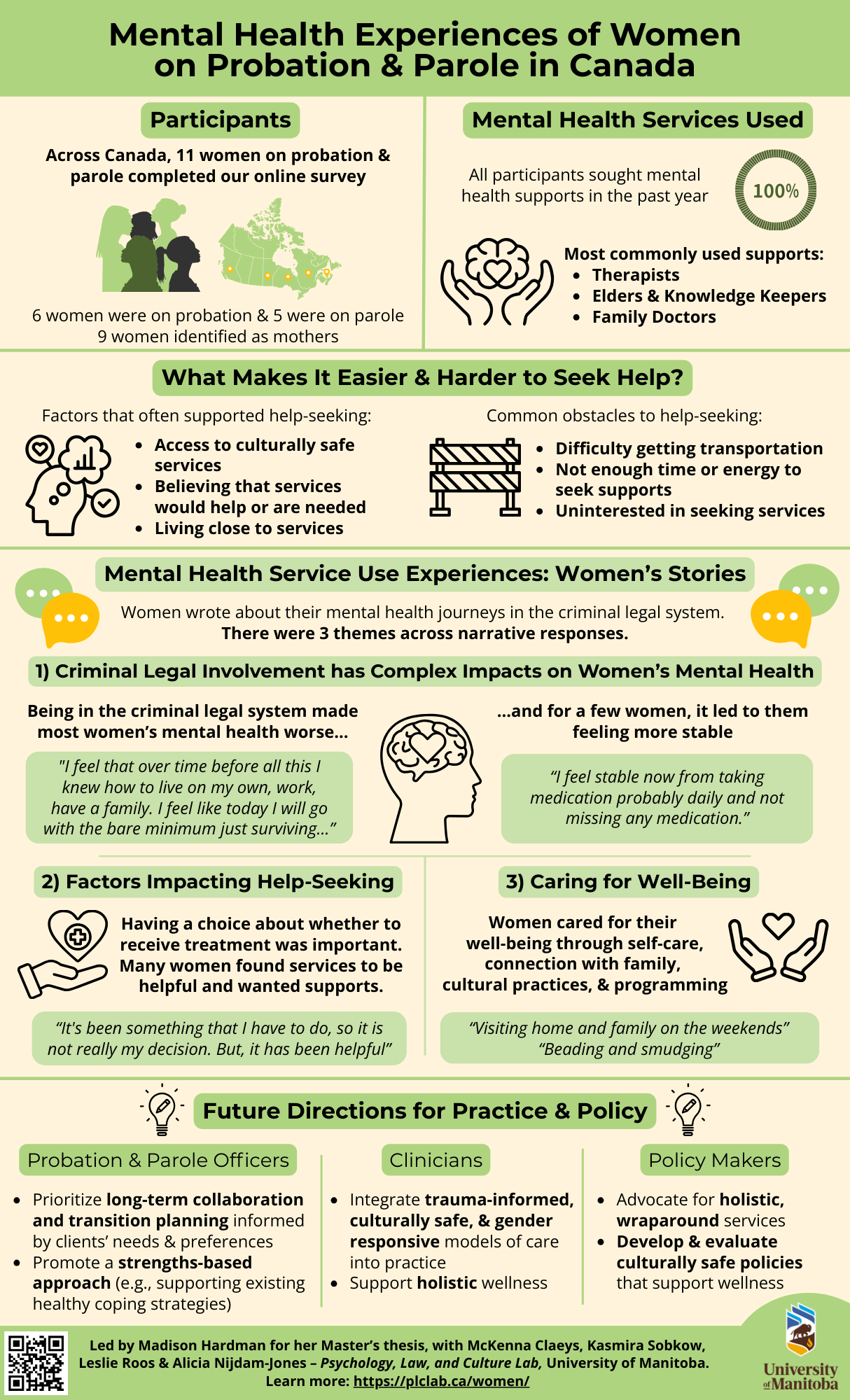
Methods: Women on probation and parole in Canada completed a 30-minute online survey about their mental health service use. In total, 11 women completed the survey between March to October 2024. Responses to open-ended questions were analyzed by two researchers using Reflexive Thematic Analysis.
Results: All participants had used mental health services in the past year. The most commonly used supports were therapists, Elders and Knowledge Keepers, and family doctors. Factors that supported help-seeking were being able to access culturally safe services, believing that services would help or were needed, and living close to services. Common obstacles to help-seeking included having difficulty getting transportation to a service, not having the time or energy to seek supports, and being uninterested in seeking supports.
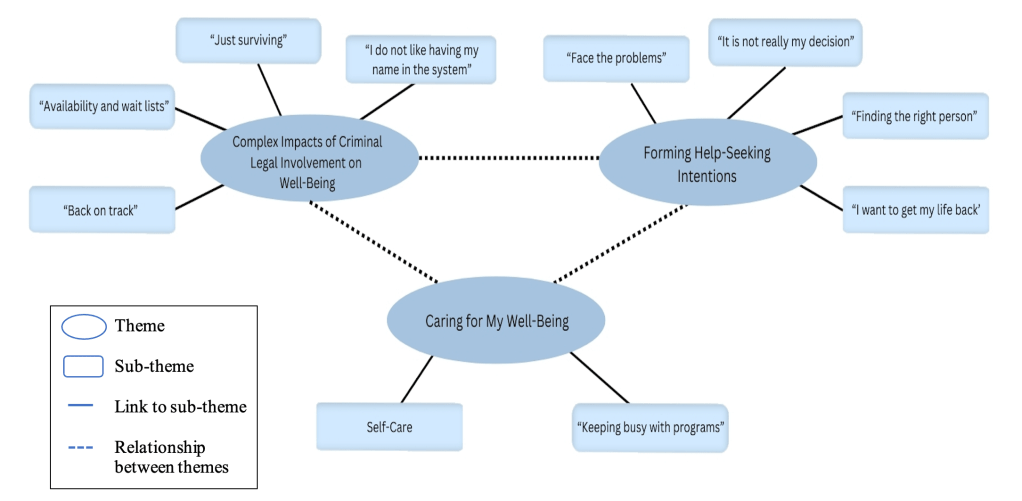
We developed three main themes from written responses: Complex impacts of criminal legal involvement on well-being (subthemes: “Back on track,” “Availability and wait lists,” “Just surviving,” and “I do not like having my name in the system”), Forming help-seeking intentions (subthemes: “Face the problems,” “It is not really my decision,” “Finding the right person,” and “I want to get my life back”), and Caring for my well-being (subthemes: Self-care, “Keeping busy with programs”).
Significance & Recommendations: Our results highlight the mental health service use needs and preferences of women on probation and parole across Canada. Findings show that it is important to use a strengths-based approach and give women as much choice as possible when making treatment plans. This may help probation and parole officers create treatment plans that match their client’s needs and goals. Clinicians who work with women on probation and parole are encouraged to use a holistic model of care that is culturally safe, trauma-informed, and gender-responsive. Based on our participants’ treatment needs and preferences, policymakers should consider supporting holistic, wraparound services for women on probation and parole to support their wellness.
Research Team
Our research team includes graduate and undergraduate students and faculty from the University of Manitoba. We have experience in clinical and forensic psychology, and some of us have worked with justice-involved individuals in our clinical practice and research. This was our first time working on research involving women on probation and parole.
The research analyses were completed by Madison and McKenna. During the analysis, we used our knowledge of the criminal legal system to help understand participants’ stories. We also reflected on how our identities as White settler and Métis cis-gender women may have impacted our understanding of participants’ experiences.
Throughout this study, Madison met with Métis Elder Charlotte Nolin to discuss the research design, analysis plan, results, and how to meaningfully share the study findings. We would like to thank Elder Charlotte for all of her guidance on this project.
Lastly, we would like to thank and acknowledge the justice-involved women residing in the community who reviewed and piloted our survey and offering recommendations for improvement. We are also grateful to the correctional ministries and community organizations for sharing the research poster and supporting recruitment.
Research Materials
This research was conducted for Madison’s master’s thesis and we are in the process of publishing our findings within a peer-reviewed academic journal. A more detailed overview of the study can be found in her thesis defence slides:
The pre-registration for this study is available on the Open Science Framework at https://osf.io/bt7q8.
For more information about this study, please contact Madison Hardman at hardmanm@myumanitoba.ca.
 PLC Lab